

Enterprise AI adoption is no longer limited to a small number of centrally purchased platforms.
Employees are signing up for AI services directly. Developers are connecting models through APIs. Teams are adopting specialized AI applications. Browser extensions are adding AI capabilities to existing workflows. SaaS platforms are embedding AI into products that organizations already use. AI agents are beginning to connect applications, access information and take actions on behalf of users.
This creates a new enterprise management problem.
The question is no longer simply:
Which AI providers have we approved?
The more important question is:
What AI actually exists across the enterprise, who is using it, what does it access, how is it connected, what does it cost, and is it governed?
That is the real scope of Shadow AI.
Shadow AI Is Not Just an Unapproved AI Application
Shadow AI is often described as employees using an AI service without approval from IT or security.
That is part of the problem, but it is becoming an incomplete definition.
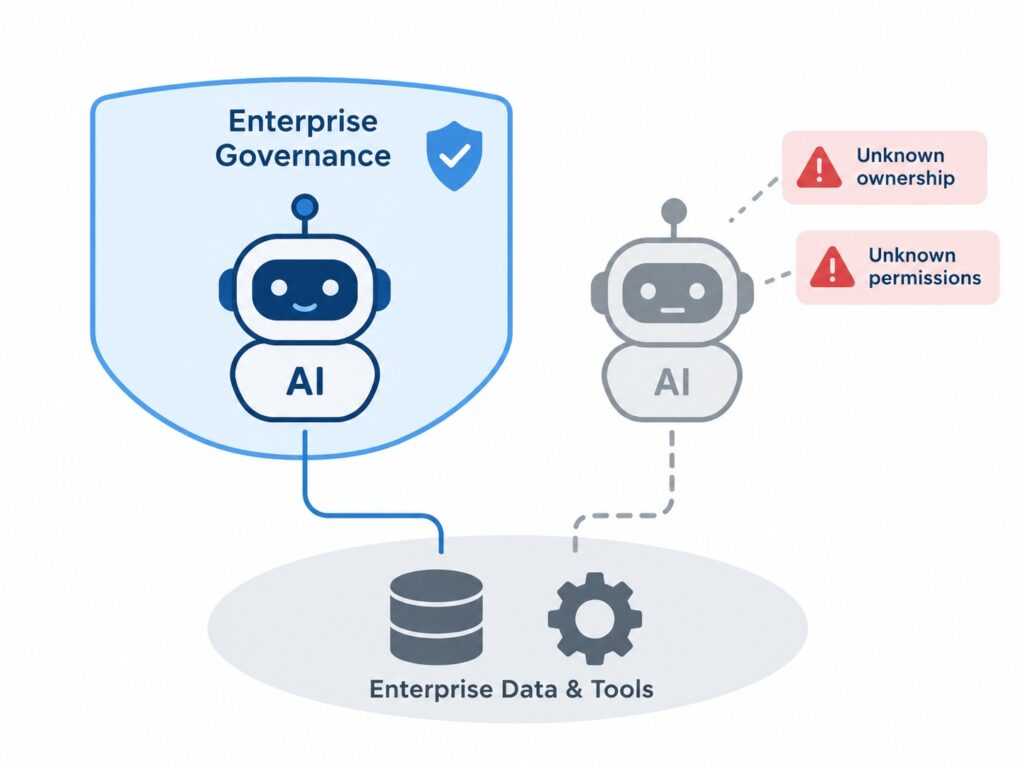
Microsoft now describes Shadow AI as including both unsanctioned AI tools adopted by employees and unmanaged AI agents operating without registration, ownership or governance.
A modern Shadow AI environment may therefore include:
- an unapproved AI provider,
- a personal account on an otherwise approved AI service,
- an AI browser extension,
- an AI-enabled SaaS application,
- an OAuth integration connecting an AI service to corporate systems,
- an internally deployed model that was never registered,
- an AI agent with access to enterprise applications,
- an MCP connection to an external tool or service,
- or an approved AI platform being used for an unapproved purpose.
This distinction matters.
An enterprise could have a perfectly maintained list of approved AI providers and still have significant Shadow AI exposure.
AI Provider Approval Is Only One Layer of Governance
Consider a simple example.
An organization approves an AI provider for enterprise use.
At first glance, that appears governed.
But several questions remain:
Is the employee using the corporate account or a personal account?
Which model or service is being used?
Is corporate information being uploaded?
Has the user connected the service to another business application?
Does an AI agent have permission to perform actions?
Is the usage associated with the correct department or project?
Who owns the activity?
How much does it cost?
Does the organization have evidence that the AI activity complies with its policies?
And ultimately:
What business value is being created?
Provider approval cannot answer those questions by itself.
This is why enterprises need to distinguish between AI provider management and AI governance.
The provider is only one object in a much larger AI environment.
The Visibility Gap Is Already Significant
Recent industry research suggests that enterprise visibility is not keeping pace with adoption.
Okta’s 2026 research found that 52% of surveyed knowledge workers had used an AI tool for work without explicit IT or security approval, while 24% said they did so regularly. At the same time, 90% of surveyed executives said they were confident in their organization’s visibility into AI tools.
That gap between management confidence and actual employee behavior is significant.
The research also found that among employees using unapproved AI tools:
- 54% had shared internal messages or emails,
- 45% had shared HR-related information,
- 39% had shared confidential company documents.
Convenience appears to be an important factor. 80% of users of unapproved tools said using their own accounts was easier, while 57% said the official approval process was too slow or difficult.
Shadow AI therefore should not automatically be interpreted as malicious behavior.
Often, it is a symptom of a gap between what employees need and what the organization’s approved technology environment provides.
That makes blanket prohibition a weak governance strategy.
Blocking AI Does Not Equal Governing AI
Organizations understandably want to protect corporate information, meet regulatory requirements and reduce security risk.
Blocking an inappropriate AI service can absolutely be necessary.
But blocking alone is not an AI governance model.
Push Security argues that organizations should create a governed path for AI adoption instead of relying only on broad barriers. Its browser telemetry shows the complexity of the environment it observes: the average organization in its customer telemetry had 16 AI applications, 17 AI browser extensions and 17 AI OAuth integrations active during a typical week. These figures are Push Security telemetry and should not be interpreted as universal enterprise averages.
The important point is the variety.
Shadow AI can appear through applications, identities, extensions, integrations and increasingly through agents.
Security technologies can provide critical evidence and enforcement at these layers.
Enterprise governance then needs to turn that evidence into management context and decisions.
The two functions are related, but they are not identical.
Discovery Must Come Before Governance
An organization cannot meaningfully govern an AI asset that it does not know exists.
That makes AI discovery the foundation of Shadow AI management.
Discovery should go beyond a manually maintained list of AI vendors.
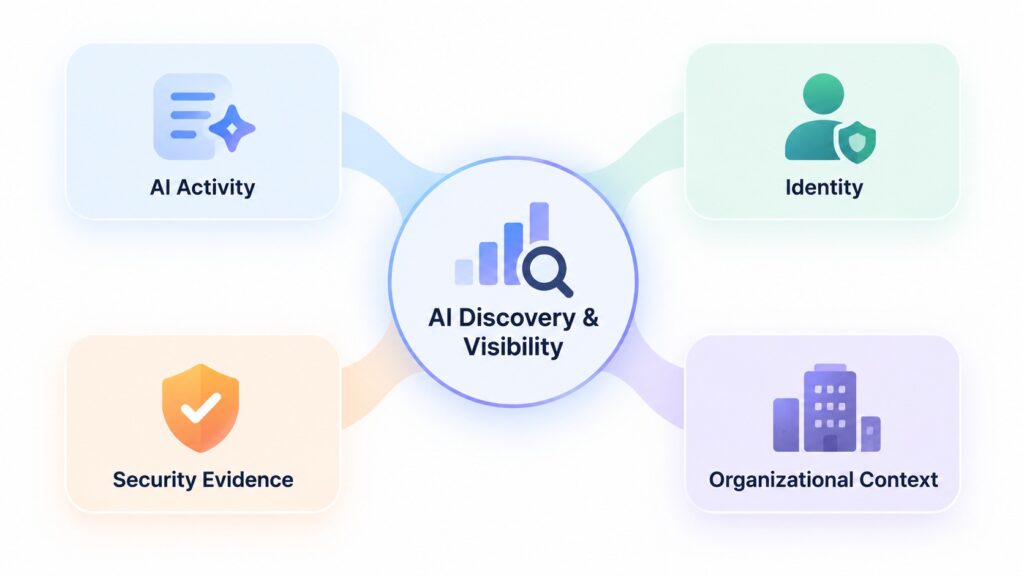
Organizations increasingly need evidence from multiple sources, including:
Provider evidence: AI platforms, APIs, subscriptions, models and usage data.
Security evidence: DLP, CASB, SWG, endpoint and other security telemetry.
Identity evidence: users, accounts, authentication and organizational identity.
Application evidence: SaaS applications, integrations and connected services.
Agent evidence: deployed agents, executions, tools and external connections.
Organizational evidence: departments, teams, projects, cost centers and responsible owners.
No single source necessarily provides the complete picture.
A network security product may identify access to an AI application. An identity platform may identify an account. An AI provider may supply token and usage data. A financial system may show cost. A project system may provide evidence of business output.
The governance challenge is connecting these pieces.
Discovery Without Context Creates Another Inventory
Finding an AI service is useful.
Knowing what that discovery means is much more useful.
Imagine that an organization detects the same AI application being used by two employees.
One user is a software developer using an approved enterprise account against non-sensitive test data.
The other is an employee using a personal account and uploading confidential customer information.
Technically, both observations involve the same provider.
From a governance perspective, they are completely different.
This is why Shadow AI management requires organizational context.
AI observations need to be associated, where evidence permits, with dimensions such as:
User
Team
Department
Business unit
Cost center
Project
Repository
Owner
Approval status
Data exposure
Policy status
Only then can an enterprise determine whether an observation represents expected usage, an optimization opportunity, a governance gap or a genuine risk.
Agents Make Shadow AI More Important, Not Less
The arrival of AI agents expands the problem further.
Traditional AI tools generally wait for a user to initiate an interaction.
Agents can be given objectives, tools and permissions and may perform sequences of actions across systems.
That changes the governance question from:
“Which AI application did the employee use?”
to questions such as:
Which agent exists?
Who owns it?
What identity does it operate under?
Which tools can it access?
Which systems can it modify?
What actions has it performed?
Can a human intervene?
Is its activity traceable?
Microsoft’s current Shadow AI guidance explicitly includes unmanaged agents as part of the enterprise Shadow AI problem.
MCP and other mechanisms for connecting models and agents to tools make this particularly important.
An AI capability is no longer necessarily isolated inside one application.
It can become part of a chain of applications, identities, tools, data and actions.
Security Risk Is Only Part of the Shadow AI Problem
Most Shadow AI discussions begin with security and data loss.
Those issues are legitimate.
Microsoft, for example, identifies data leakage, compliance violations, security vulnerabilities and lack of auditability as risks associated with unmanaged AI.
But enterprises eventually encounter another problem:
AI sprawl costs money.
Multiple departments may purchase overlapping AI services.
Employees may hold unused or lightly used licenses.
Several providers may be performing similar functions.
API usage may increase without clear ownership.
AI costs may be distributed across invoices, cloud accounts, subscriptions and development environments.
An organization can therefore have both Shadow AI risk and Shadow AI cost.
This means governance also needs to connect discovered AI activity with consumption and financial context.
Questions begin to include:
Which providers are actually being used?
Which teams are driving consumption?
Which licenses are inactive?
Where is spend concentrated?
Are multiple services solving the same problem?
Can costs be attributed to the business units creating them?
Security visibility alone cannot answer all of these questions.
And Cost Still Does Not Tell You Whether AI Is Valuable
There is an even larger management question.
Suppose an organization discovers all of its AI services.
It understands usage.
It knows the cost.
It assigns ownership.
It reduces the most obvious risks.
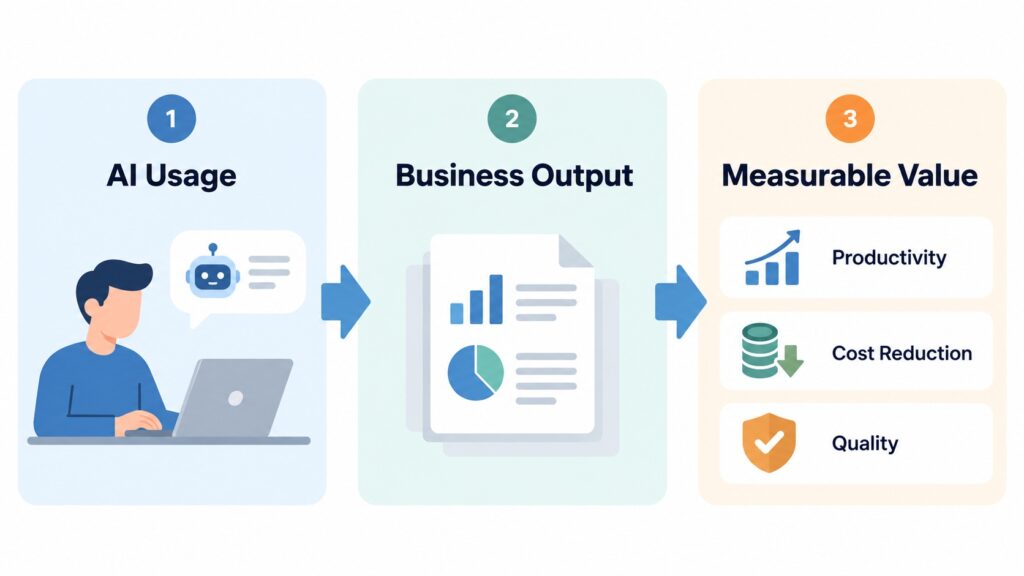
That still does not tell leadership whether its AI investment is delivering business value.
High usage can indicate successful adoption.
It can also indicate expensive experimentation.
A large number of prompts, requests or consumed tokens is not a business outcome.
Organizations eventually need to connect:
AI Usage → Work Output → Accepted Output → Business Outcome → Measurable Value
For example, an AI coding assistant should not ultimately be judged only by the number of active users.
Enterprises may want to understand whether its usage contributes to accepted development output, faster delivery, improved quality or another defined business result.
The same principle applies to AI used in marketing, operations, customer service, finance and other functions.
Moving From Shadow AI Detection to AI Governance
This is where AssetUno AI approaches Shadow AI as part of a wider enterprise AI management problem.
The objective is not to replace security controls that block uploads, inspect browser activity or enforce endpoint policy.
Those technologies have a different and necessary role.
AssetUno AI is designed to bring AI evidence into a broader management and governance context.
That means connecting available evidence across AI providers, security sources, identity systems and organizational context, then turning it into a structured view of enterprise AI.
The operating model can be understood in five stages:
1. Collect
Bring together authorized evidence from AI providers, security systems, identity sources and business outcome systems.
2. Normalize
Preserve provider-specific detail while normalizing common concepts such as AI activity, usage and cost.
3. Attribute
Connect AI evidence to organizational dimensions such as users, teams, departments, cost centers, projects and repositories.
4. Compare
Evaluate providers and AI activity across adoption, cost, value and governance evidence.
5. Act
Use the resulting evidence to support governance actions, ownership decisions, optimization, budgeting and management review.
This turns Shadow AI from a list of suspicious applications into a decision process.
What Enterprises Actually Need to Govern
The enterprise AI landscape is moving beyond a simple approved-provider list.
Organizations increasingly need visibility across several connected layers:
Providers and models: Which AI platforms and models exist?
Applications: Which AI-enabled applications are being used?
Identity: Who or what is accessing them?
Integrations: What systems and data are connected?
Agents: Which autonomous or semi-autonomous capabilities are operating?
Usage: How much activity is taking place?
Cost: Who owns the spend and is it justified?
Risk: Is the activity approved and appropriately controlled?
Governance: Who owns the decision and what action is required?
Value: What measurable outcome does the AI investment produce?
This is why Shadow AI cannot remain only a security term.
It is becoming an enterprise management discipline.
The Goal Is Not to Eliminate AI. It Is to Eliminate Blind Spots.
AI adoption will continue.
New providers will emerge. Existing applications will add AI capabilities. Employees will find new tools. Developers will connect new models. Agents will gain access to more enterprise systems.
Trying to maintain governance through a static list of approved AI providers will not scale with that environment.
The objective should instead be to create a continuously understandable AI landscape.
Enterprises need to know:
What AI exists?
Where did it come from?
Who owns it?
Who is using it?
What can it access?
What does it cost?
What risk does it create?
What value does it deliver?
What action should we take?
Shadow AI begins with something the organization cannot see.
Effective AI governance begins when that activity becomes visible, attributable, explainable and actionable.
That is the difference between simply adopting AI and actually managing it.