AssetUno AI is an Enterprise AI Cost, Usage & Value Management platform. It brings authorized cost, consumption, adoption and outcome data from supported AI APIs, developer tools and enterprise AI workspaces into one structured management view.
Know what AI you use. Know what it costs. Know what it delivers.
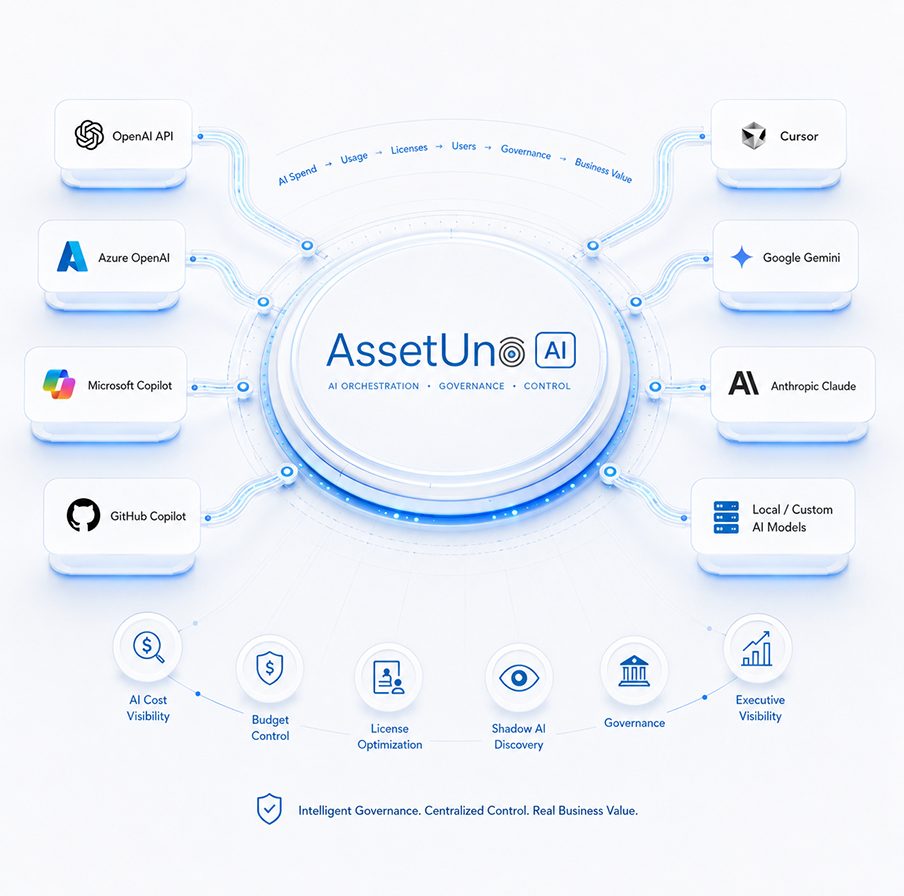
Bring enterprise AI spend, adoption and value into one view.
AI usage is often spread across subscriptions, API accounts, developer tools and enterprise workspaces. AssetUno AI turns fragmented provider data into a structured management view.
Turn fragmented AI data into accountable decisions
AssetUno AI collects data from connected AI platforms, preserves provider-native metrics and transforms them into a consistent enterprise management layer. Usage, cost and adoption data can then be attributed to organizational context, compared and turned into actionable insights.
Discover and contextualize Shadow AI usage
Identify previously unmanaged AI services from approved discovery sources, match them against the AI service catalog and add organizational context such as users, departments, vendors and cost centers.
AssetUno AI helps make Shadow AI visible so organizations can evaluate usage, ownership, cost and governance needs before deciding what action to take.

Connect AI usage with organizational context
AssetUno AI maps usage and cost to users, teams, departments, cost centers, projects and repositories, helping organizations understand who is using AI, where consumption occurs and which business context it belongs to. This adds accountability beyond individual provider accounts or invoices.
Shadow AI Spenditure. AI Cost. AI Adoption. AI Value.
Shadow AI Spenditure. AI Cost. AI Adoption. AI Value.
Shadow AI Spenditure. AI Cost. AI Adoption. AI Value.
Shadow AI Spenditure. AI Cost. AI Adoption. AI Value.
Shadow AI Spenditure. AI Cost. AI Adoption. AI Value.
Shadow AI Spenditure. AI Cost. AI Adoption. AI Value.
Shadow AI Spenditure. AI Cost. AI Adoption. AI Value.
Shadow AI Spenditure. AI Cost. AI Adoption. AI Value.
Shadow AI Spenditure. AI Cost. AI Adoption. AI Value.
Shadow AI Spenditure. AI Cost. AI Adoption. AI Value.
Frequently asked questions
What problem does AssetUno AI solve?
Enterprise AI usage is often fragmented across provider invoices, API accounts, coding assistants, enterprise subscriptions and team-level reports. AssetUno AI brings this information together so organizations can understand what is being used, what it costs, who is using it and where management action may be required.
Is AssetUno AI only an AI cost management tool?
No. Cost management is a core capability, but AssetUno AI also covers adoption, license utilization, organizational attribution and available outcome indicators. This allows organizations to evaluate AI investment beyond the monthly invoice.
Which AI platforms can AssetUno AI connect to?
The connector portfolio is designed to cover AI APIs, developer AI tools and enterprise AI workspaces, including OpenAI API, Azure OpenAI, Azure AI Foundry, Cursor, GitHub Copilot, Google Gemini, Anthropic Claude, Claude Code and ChatGPT Enterprise.
Connector availability, metric detail and historical coverage depend on provider capabilities, subscription plans, API availability and granted permissions.
How does AssetUno AI collect data?
AssetUno AI uses authorized APIs, exports and customer-approved data feeds. Data collection is scheduled and controlled by the customer, and standard provider integrations do not require a broad endpoint agent deployment.
How does AssetUno AI help with Shadow AI?
AssetUno AI can use approved identity, security, network, expense, procurement, contract and discovery evidence to identify and contextualize previously unmanaged AI usage.
Observed services can be associated with information such as users, departments, vendors, ownership, usage activity and governance status, helping organizations evaluate Shadow AI before deciding what action to take.
Can AssetUno AI identify unused or underused AI licenses?
Where providers expose license assignment and activity data, AssetUno AI can identify inactive or lightly used seats and provide evidence to support license reallocation, recovery and renewal decisions.
Does AssetUno AI collect prompts, responses or source code?
AssetUno AI is designed primarily around management metadata such as cost, usage, identity, model, workspace, repository and outcome indicators.
Prompt contents, model responses and source-code contents are not required for standard cost and adoption use cases unless a customer explicitly configures an approved use case requiring such data.
