

Enterprise AI is moving from systems that answer questions to systems that can act.
That changes the governance problem.
An AI agent may receive an objective, decide how to approach it, choose tools, access enterprise data, call APIs, interact with other systems, delegate work to sub-agents and execute a multi-step process without continuous human involvement.
Traditional software governance was largely designed around predictable applications, known integrations and relatively stable permissions.
Agentic AI introduces something different.
The software is becoming an operational actor.
The Blueprint Alliance, a cross-industry initiative involving companies across identity, cloud, cybersecurity, data, applications and infrastructure, published a shared architecture in September 2026 for securing what it describes as the agentic enterprise.
Its reference architecture is built around four deceptively simple questions:
Where are my agents?
What can they do?
What are they doing?
How do I respond?
These questions capture an important shift.
AI agent governance is no longer just a model-management problem.
It is becoming an enterprise visibility, identity, security, execution and governance problem that crosses multiple technology domains at the same time.
Agent Scale Changes the Management Problem
The Blueprint Alliance whitepaper cites a Gartner forecast that an average global Fortune 500 organization could have more than 150,000 AI agents in use by 2028, compared with fewer than 15 in 2025.
It also cites research suggesting that only 13% of organizations believe they have the right AI agent governance in place.
Whether the eventual number is exactly 150,000 is less important than the direction of travel.
Agent populations can scale far faster than traditional enterprise applications.
An organization may have:
internally developed agents,
SaaS-based agents,
agents embedded within business applications,
developer-created orchestration agents,
local assistants,
customer-facing agents,
specialized sub-agents,
and autonomous workflows built across multiple providers.
The management challenge increases further because these agents may not remain static.
They can change models.
They can gain new tools.
They can inherit permissions.
They can interact with new systems.
They can spawn sub-agents.
They can execute long after the original human interaction has ended.
A spreadsheet-based inventory or annual governance review was never designed for this environment.
The Four Questions Define a New Governance Model
The strength of the Blueprint Alliance architecture is that it begins with operational questions rather than abstract AI principles.
Where are my agents? is fundamentally a discovery and ownership question.
What can they do? is an identity, permission and policy question.
What are they doing? is an execution, monitoring and evidence question.
How do I respond? is an enforcement, containment and recovery question.
These questions are connected.
You cannot meaningfully restrict an agent you do not know exists.
You cannot evaluate its actions without understanding its identity and permissions.
You cannot investigate an incident without execution evidence.
And you cannot safely automate containment without reliable telemetry and context.

Discovery Has to Come Before Policy
The first governance problem is visibility.
The Blueprint Alliance makes this explicit: organizations cannot govern or protect agents they do not know exist.
That sounds obvious.
In practice, it is becoming increasingly difficult.
An agent may appear through a cloud platform.
It may be embedded in a SaaS application.
It may be built by a development team.
It may enter through an external marketplace or registry.
It may run locally.
It may operate through an MCP connection.
It may be created dynamically by another agent.
It may exist without a traditional procurement event ever taking place.
This is where Shadow AI becomes Shadow Agentic AI.
The enterprise may know which AI platforms it purchased while still having incomplete visibility into which agents are actually executing, where they came from, which resources they can reach and who is accountable for them.
Discovery therefore needs to become continuous.
It also needs context.
A useful agent inventory cannot stop at a technical identifier.
It should help answer:
Who built or introduced the agent?
Who owns it?
Which business process does it support?
Which model does it use?
Which tools and systems can it reach?
What level of autonomy does it have?
Is it approved, unmanaged or unknown?
Without those relationships, an agent directory risks becoming another technical inventory with limited management value.
Agent Identity Is Necessary, But Identity Alone Is Not Governance
The Blueprint Alliance argues that hosted AI agents should be treated as distinct security identities.
This is an important principle.
An autonomous agent acting on behalf of a person or process should not simply inherit a shared service account and disappear inside traditional machine identity.
Its identity needs to be connected to ownership, scope, lifecycle state and delegated authority.
But identity is only the starting point.
An agent with a verified identity can still have excessive access.
It can still use the wrong tool.
It can still act outside the business purpose for which it was introduced.
It can still generate unexpected cost.
It can still create an unacceptable operational or compliance risk.
It can still deliver little business value.
Enterprise agent governance therefore needs to connect identity with purpose, permissions, ownership, execution, risk and outcome.

Delegation Creates a New Kind of Permission Problem
Human access governance generally assumes that a known person authenticates and receives permissions based on role, policy and context.
Agentic systems complicate that model.
A person may delegate a task to an agent.
That agent may delegate part of the task to another agent.
The second agent may call an external tool.
The tool may access a database.
The result may trigger an action in another enterprise application.
The governance question is no longer simply:
Does this identity have access?
It becomes:
Does this agent have the right to perform this specific action, for this specific purpose, on behalf of this specific user or process, at this point in the workflow?
The Blueprint Alliance therefore emphasizes task-scoped access and traceable delegation.
That is a significant change from standing permissions.
An agent designed to retrieve customer information may not need permission to modify it.
An agent that can generate a financial transaction should not necessarily be able to approve the same transaction.
A sub-agent should not automatically gain access to everything available to its parent.
And an agent operating on behalf of a user should not silently exceed the authority of the person who delegated the task.
This makes agent governance deeply dependent on context.
MCP Expands the Governance Boundary Beyond the Agent
Model Context Protocol and similar mechanisms are making it easier for AI systems to connect with tools, data and enterprise resources.
That interoperability is valuable.
It also expands the governance boundary.
An agent may interact with:
MCP servers,
SaaS applications,
data stores,
knowledge repositories,
APIs,
command-line tools,
other agents,
payment systems,
browsers,
communication platforms,
and code execution environments.
The risk of an agent therefore depends not only on what the agent is.
It depends on what the agent can reach.
A read-only assistant connected to public documentation and an autonomous agent connected to financial systems may both be described as AI agents.
The governance requirements should not be remotely identical.
Enterprise management needs to understand the potential blast radius around each agent.

Runtime Evidence Changes What Governance Means
Traditional governance often focuses heavily on what a system was approved to do.
Agentic governance also needs evidence of what the system actually did.
The Blueprint Alliance places runtime authorization, monitoring, tracing and observability at the center of its architecture.
This matters because an agent’s intended configuration does not guarantee its actual behavior.
An approved agent may:
access an unusual volume of data,
call an unexpected API,
enter a repetitive execution loop,
respond to a prompt-injection attempt,
use a tool outside its normal workflow,
or gradually drift beyond its original task.
Governance therefore needs evidence from execution.
That can include:
which actions were performed,
which tools were invoked,
which resources were accessed,
which sub-agents participated,
which approvals occurred,
what the execution cost,
and whether the observed behavior remained consistent with the intended purpose.
This is also where traceability becomes essential.
After an incident, an organization should not have to reconstruct an agent’s behavior from disconnected logs and assumptions.
It should be able to connect the execution back to the responsible identity, owner, purpose and workflow.
Containment Is Part of the Security Stack, Not a Governance Dashboard Feature
The Blueprint Alliance goes beyond visibility and monitoring.
Its architecture includes active containment mechanisms such as token revocation, session termination, rate limiting, network quarantine and controlled recovery.
Those are important capabilities.
They also illustrate why agentic AI governance cannot be solved by one governance product alone.
Actual containment requires enforcement points inside identity systems, gateways, security platforms, networks, runtimes and application infrastructure.
A governance platform should not pretend to replace those systems.
Instead, enterprises need a model where governance and management can understand the evidence produced by those controls and coordinate decisions around it.
This distinction matters.
Governance needs to know that an agent was contained, why it was contained, which risk triggered the action, who owns the agent, what remediation occurred and whether the agent was safely restored.
The enforcement itself belongs to the security and runtime controls capable of performing it.

No Single Vendor Owns the Agentic Stack
One of the most important messages behind the Blueprint Alliance is architectural rather than product-specific.
Agentic AI crosses too many layers for a single technology category to govern the entire environment.
Identity platforms understand identities and access.
Security platforms observe threats.
Gateways inspect traffic and enforce policies.
Cloud platforms provide runtime infrastructure.
Data platforms govern information.
Application platforms expose business functions.
AI providers expose models and agent capabilities.
Observability systems provide execution evidence.
The agent sits across all of them.
This is why open standards and interoperability are becoming important.
The Blueprint Alliance references standards and protocols including MCP, OCSF, SSF, CAEP and HTTP Message Signatures as mechanisms that can help different parts of the environment exchange context, telemetry and trust signals.
The broader lesson is straightforward.
Agentic AI governance is becoming a multi-vendor problem.
The enterprise therefore needs consistency above provider-specific implementations.
Security Is Essential, But Agent Governance Is Broader Than Security
The Blueprint Alliance is intentionally security-focused.
Enterprise AI management needs to go one step further.
An agent can be secure and still be poorly governed.
It may have no clear business owner.
Its autonomy level may be inappropriate for the process.
Human intervention may not be defined.
Its execution may be technically traceable but not linked to an accountable business outcome.
Its operating cost may be increasing without corresponding value.
Its controls may not map cleanly to the organization’s governance or assurance framework.
This introduces a broader set of questions:
Who is accountable for the agent?
What business purpose does it serve?
What level of autonomy has been accepted?
Where is human intervention required?
Can its actions be reconstructed?
Which governance requirements apply?
What does it cost to operate?
What measurable outcome does it create?
This is where agent security begins to become agent assurance.
Where AssetUno AI Fits
AssetUno AI is not the runtime enforcement plane described in the Blueprint Alliance architecture.
It does not replace identity platforms, AI gateways, DLP systems, endpoint controls, network security, cloud runtimes or containment mechanisms.
Those systems remain the enforcement surfaces.
AssetUno AI addresses a different layer of the problem.
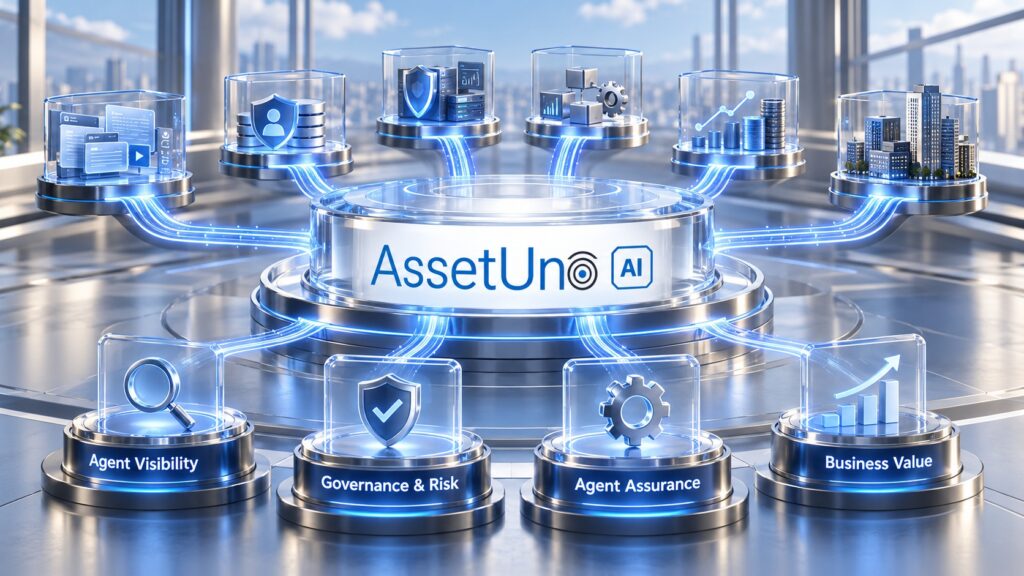
It creates a provider-independent management and governance context across the evidence those systems and AI platforms can provide.
For agentic AI, that includes several connected capabilities.
Agent Discovery and Inventory
Establish which agents are visible across connected sources, including managed and potentially unmanaged agent activity where sufficient evidence exists.
Ownership and Organizational Context
Connect agents and observed activity with responsible users, teams, departments, projects, repositories and other available organizational context.
Agentic AI Governance
Maintain management visibility into agents, executions, tools, actions, provider evidence and connections such as MCP.
Governance and Risk
Connect agent evidence with ownership, governance requirements, risks, exceptions and management actions.
Agent Assurance
Evaluate evidence around autonomy, oversight, traceability, human intervention and other assurance expectations rather than treating agent existence as proof of control.
Usage and Cost Optimization
Connect available agent, model and provider consumption evidence with cost and organizational attribution.
AI Value and Outcomes
Extend governance beyond security by asking whether agent activity produces accepted work and measurable business outcomes.
The objective is not to duplicate every underlying security control.
It is to create a management layer where the organization can understand what exists, who owns it, what evidence is available, which risks require action and whether the agent is creating value.
The Next Phase Is Continuous Agent Governance
The Blueprint Alliance whitepaper ends with a practical sequence that captures the maturity challenge well.
Start with telemetry.
Discover agents before writing policy.
Register agents before restricting them.
Establish runtime evidence before automating response.
Test containment before relying on it.
And treat governance as a continuous operating model rather than a one-time project.
That final point may be the most important.
Agentic AI changes too quickly for static governance.
The model can change.
The tools can change.
The permissions can change.
The owner can change.
The agent can delegate work.
The execution path can change.
The business purpose can change.
The risk can change.
The value can change.
Enterprise agent governance therefore cannot be a certification that happened six months ago.
It has to become a continuous evidence problem.
The organizations that scale agentic AI successfully will need to answer the same four questions repeatedly:
Where are our agents?
What can they do?
What are they doing?
How should we respond?
And enterprise management will need to add several more:
Who owns them?
Are they sufficiently assured?
What do they cost?
What business outcome do they create?
That is the shift from securing individual AI agents to governing agentic AI at enterprise scale.
Primary Reference: Blueprint Alliance, Governing Agentic Execution: An Architectural Blueprint for the Secure Agentic Enterprise, September 2026
The Blueprint Alliance whitepaper presents an open, cross-industry reference architecture for governing agentic execution across discovery, identity, access, runtime monitoring, resource access, response and recovery.