
Artificial intelligence adoption in Türkiye is moving from experimentation toward mainstream business use.
The Turkish Statistical Institute’s Artificial Intelligence Statistics 2026, published on October 2, 2026, provides a clear indication of that acceleration. The percentage of individuals using generative AI increased from 19.2% in 2025 to 37.6% in 2026, while the percentage of enterprises using at least one AI technology increased from 7.5% to 14.0% in the same period.
The numbers are important, but the more significant question for enterprises is what comes next.
As AI adoption grows across departments, employees, platforms and business processes, organizations need to know not only whether AI is being used, but also which AI is being used, where it is being used, what data it touches, what it costs, what risks it creates and whether it produces measurable business value.
That is where AI adoption becomes an AI governance problem.
Enterprise AI Is Moving Beyond Early Experimentation
AI adoption is already significantly higher among larger organizations.
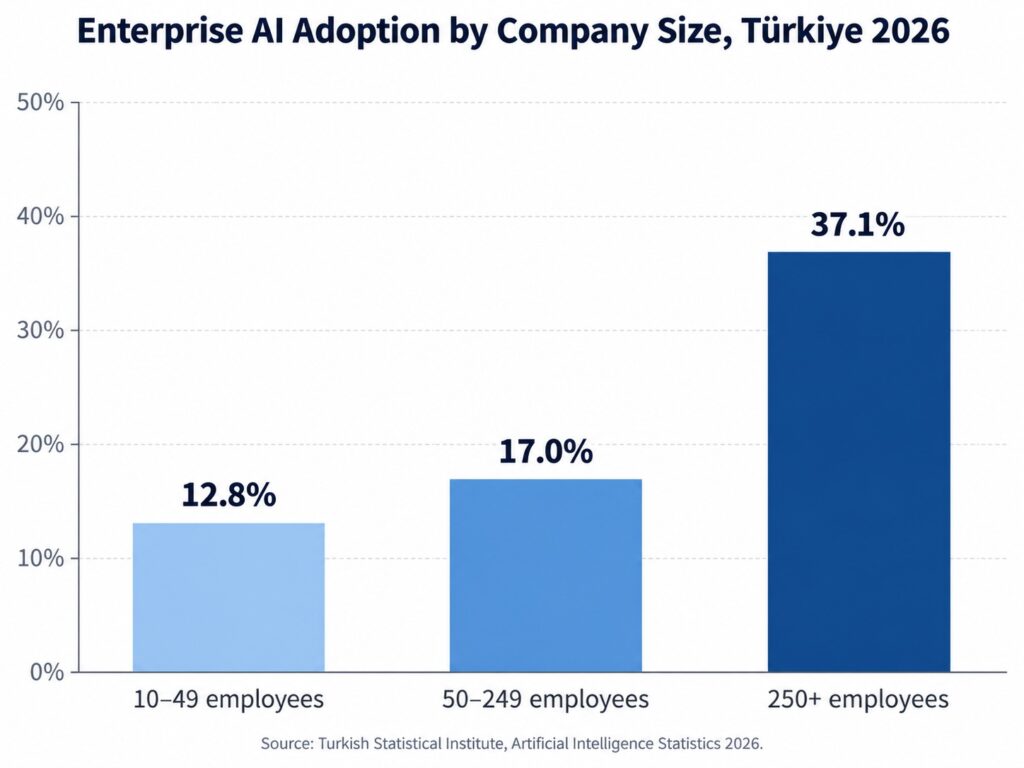
According to TurkStat, 37.1% of enterprises with 250 or more employees used AI technologies in 2026, compared with 17.0% of enterprises with 50 to 249 employees and 12.8% of those with 10 to 49 employees. In 2021, AI usage among enterprises with 250 or more employees was only 9.6%.
This means that for large enterprises, AI can no longer be treated simply as an innovation experiment managed by a small technology team.
AI may now exist across marketing, development, customer service, analytics, operations, productivity tools and business applications at the same time.
Sector differences are even more striking.
AI usage reached 63.7% among enterprises operating in telecommunications, computer programming and information-related activities, while publishing, broadcasting and content-related activities reached 57.1%.
For technology-intensive organizations, AI is therefore rapidly becoming part of normal enterprise infrastructure.
And infrastructure requires management.
The AI Environment Is Becoming More Complex
Another important finding is how enterprises acquire their AI capabilities.
Among enterprises already using AI, 67.8% reported using open-source AI software, while 49.1% used free or paid proprietary software. Some organizations also relied on external providers to develop AI systems, while others developed systems internally. Multiple acquisition methods could be reported.
This creates a potentially fragmented enterprise AI landscape.
An organization may simultaneously have:
- commercial generative AI subscriptions,
- embedded AI capabilities inside SaaS applications,
- internally developed models,
- open-source models,
- cloud AI services,
- developer-focused AI assistants,
- externally developed AI solutions,
- and AI tools adopted directly by individual employees or business teams.
The issue is no longer simply selecting an AI provider.
The issue is maintaining an accurate inventory of the organization’s AI footprint.
Shadow AI: What You Cannot See, You Cannot Govern
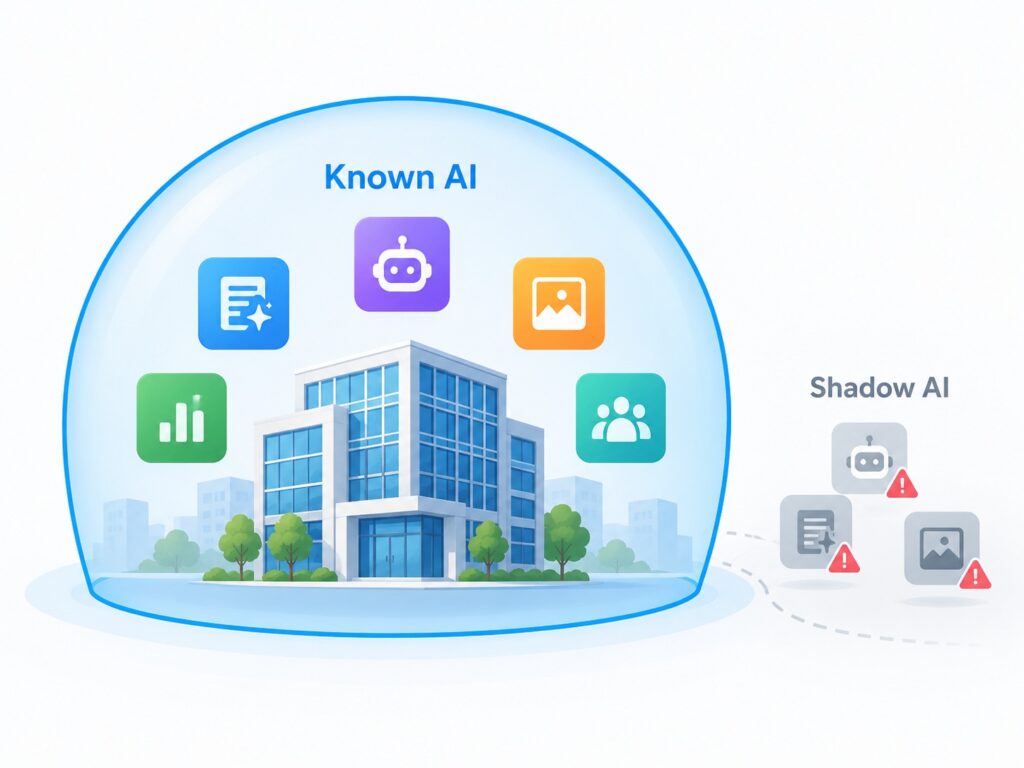
This is where Shadow AI becomes increasingly relevant.
Shadow AI describes AI tools, models or services used inside an organization without sufficient visibility, approval or governance from the functions responsible for IT, security, procurement, risk or compliance.
TurkStat does not measure Shadow AI directly, so the 2026 statistics should not be interpreted as evidence of a specific level of unauthorized AI use in Türkiye.
They do, however, show the conditions under which the problem becomes increasingly important: rapidly increasing adoption, multiple technology acquisition models and AI expanding across business functions.
An employee using an external generative AI service may only be trying to work faster. But if sensitive corporate information, intellectual property, customer information or personal data enters a tool that the organization does not know about, a productivity decision can quickly become a governance issue.
Traditional software inventory alone may not provide enough visibility.
Organizations increasingly need to understand the relationships between AI providers, models, applications, users, organizational context, usage and data exposure.
Data Privacy Is Already Part of the AI Adoption Story
The TurkStat research provides another significant signal.
16.6% of enterprises using AI reported processing personal information through AI technologies, including information such as age, occupation, education, address, purchase history or facial images.
At the same time, organizations considering AI but not yet using it reported substantial concerns.
The largest obstacle was lack of relevant expertise at 72.3%. This was closely accompanied by legal uncertainty at 66.4% and concerns about data protection and privacy violations at 65.4%.
These results matter because they show that enterprise AI adoption is not being limited primarily by a lack of potential use cases.
Organizations are also asking:
Who is responsible when an AI system causes harm?
What information is being processed?
Which provider or model is involved?
Where does the data go?
Which regulatory or internal requirements apply?
Can the organization prove that appropriate controls exist?
These are governance questions, not simply technology questions.
For organizations operating in or serving the European Union, this becomes even more relevant. Major provisions of the EU AI Act became applicable on August 2, 2026, including new transparency requirements for certain AI systems, while other obligations, particularly for high-risk systems, continue to phase in.
AI governance is therefore moving from policy documents into day-to-day operational management.
Adoption Alone Does Not Demonstrate Business Value
There is another side to the data that deserves equal attention: value.
Among enterprises using AI in 2026, the most common business purpose was marketing or sales at 51.0%, followed by research, development or innovation at 46.3% and production or service processes at 43.4%.
Those statistics tell us where AI is being applied.
They do not tell us whether those investments are creating value.
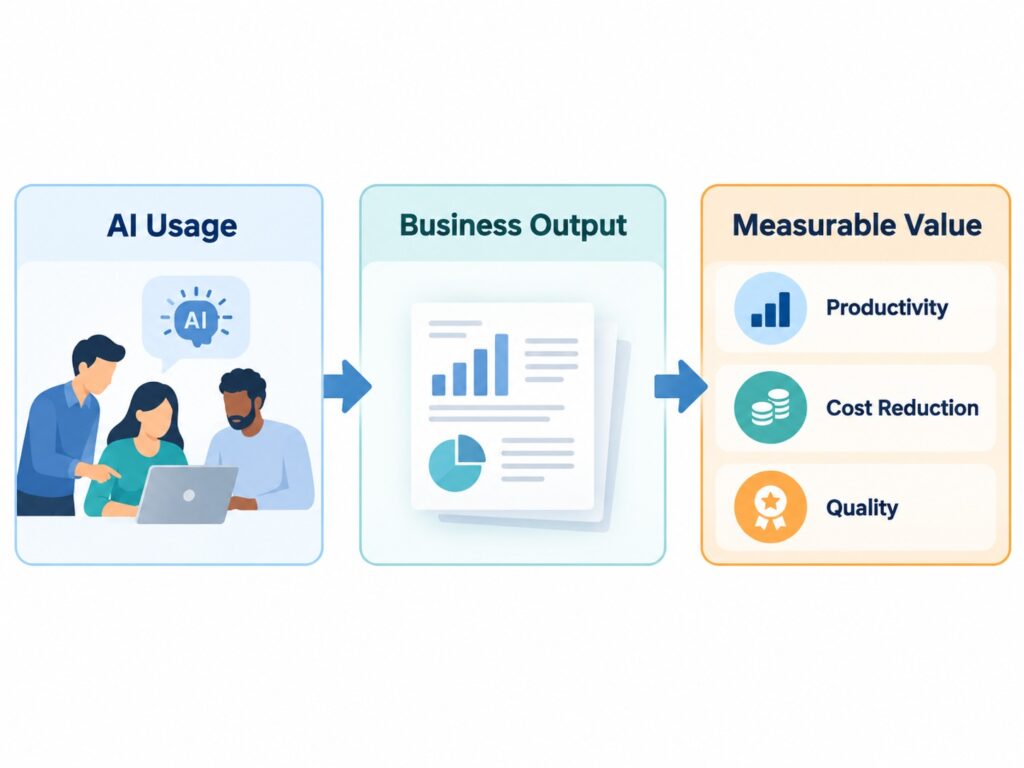
An organization may know that 500 employees have access to an AI service and that millions of tokens have been consumed. That still does not answer whether AI has reduced operating cost, accelerated product delivery, increased accepted work output, improved service quality or contributed to a measurable business outcome.
This distinction will become increasingly important as AI spending grows.
AI consumption is not the same as AI value.
Organizations need to move beyond usage reporting and connect AI activity to accepted outputs and eventually to business outcomes.
From AI Inventory to AI Value and Governance
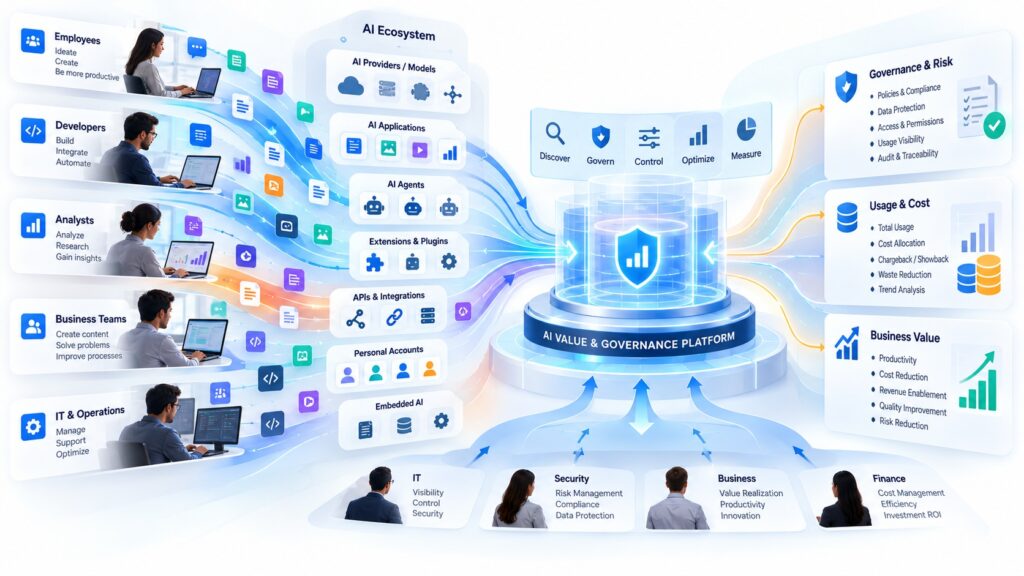
This is the problem space AssetUno AI is designed to address.
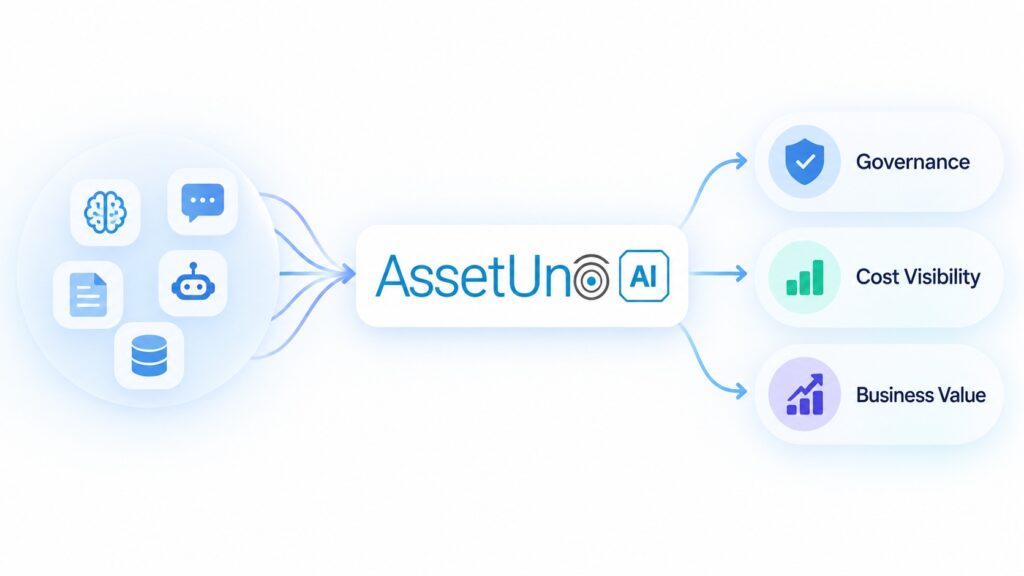
Instead of managing AI purely as another software category, AssetUno AI approaches enterprise AI as a connected value and governance environment.
The objective is to give organizations visibility across the AI lifecycle:
Discover which AI providers, models, applications and services exist across the organization.
Identify Shadow AI and distinguish governed AI usage from activity that requires investigation or organizational context.
Understand usage and cost across multiple providers rather than evaluating every AI platform independently.
Apply governance and assurance context so AI usage can be evaluated against internal policies, risk requirements and relevant standards or regulatory frameworks.
Connect AI activity to work outputs and outcomes so organizations can evaluate whether AI investment creates measurable business value.
This creates a different management model.
Instead of asking:
“How much AI are we using?”
Enterprises can begin asking:
“Which AI are we using, where is it being used, is it governed, what does it cost, what risk does it introduce and what value does it actually create?”
The Next Phase of Enterprise AI Is Management
The 2026 TurkStat statistics show that AI adoption in Türkiye is accelerating quickly.
That is good evidence of technological adoption.
But adoption itself is no longer the difficult part.
As AI spreads across employees, business units, external services, internally developed applications and emerging AI agents, enterprises will increasingly need a management layer capable of answering basic but critical questions:
What AI do we have?
Who is using it?
What data does it touch?
Is it approved and governed?
What does it cost?
What business outcome does it support?
Organizations that cannot answer these questions may still be adopting AI rapidly.
They simply will not be managing it.
The next stage of enterprise AI maturity will therefore not be defined by who uses the most AI.
It will be defined by who can discover, govern, measure and demonstrate the value of AI across the enterprise.
Reference: Turkish Statistical Institute (TurkStat), Artificial Intelligence Statistics 2026, October 2, 2026.