

Financial services has used artificial intelligence for decades.
What is changing now is not simply the amount of AI being used.
It is what AI is allowed to do.
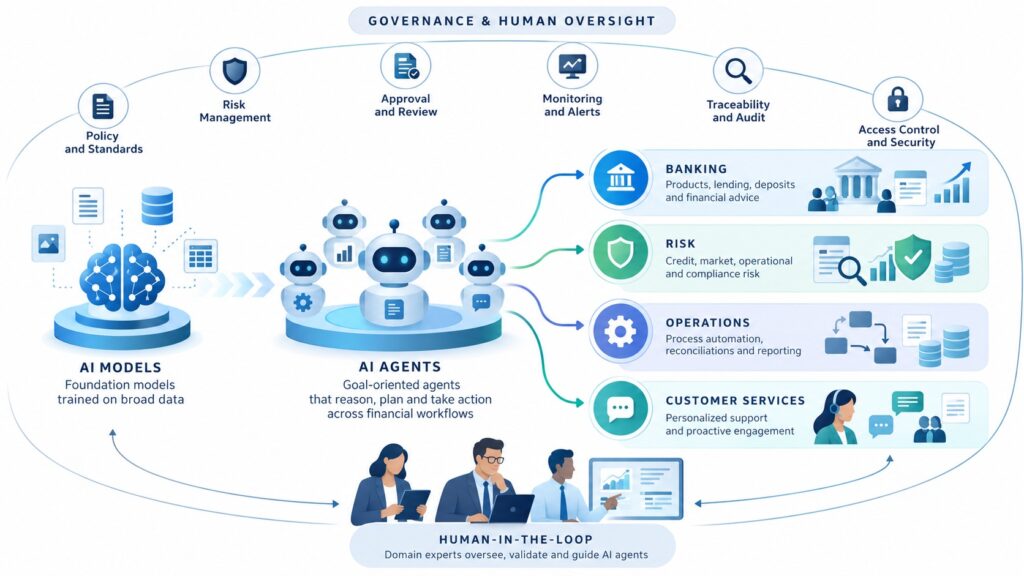
Traditional machine learning helped financial institutions predict, classify and detect patterns. Generative AI expanded those capabilities into language, content and reasoning. Agentic AI goes further by allowing AI systems to plan, decide, use tools, interact with other systems and execute multi-step processes.
That changes the governance problem fundamentally.
The World Economic Forum’s The AI Playbook for Financial Services, developed in collaboration with Accenture and published in June 2026, describes this shift as financial institutions move from experimentation toward scaled deployment. The report was informed by more than 150 senior leaders from over 100 organizations, together with industry roundtables, interviews, case studies and research.
Its central message is clear: AI is becoming part of the operating model of financial services, and governance must become part of that operating model as well.
Financial Services Is Moving Beyond AI Experimentation
The financial sector is already expanding its AI ambitions.
The World Economic Forum report notes that organizations are increasing investment in generative AI, agentic AI and the infrastructure needed to support them, moving beyond isolated pilots toward broader enterprise integration.
Data from the report shows that 42% of financial services institutions surveyed were already using or assessing agentic AI, alongside 61% for generative AI and large language models and 68% for data analytics.
This matters because agentic AI represents a different operational model.
A model provides an output.
An agent can potentially take the next step.
It may retrieve information.
It may call an API.
It may interact with another agent.
It may trigger a transaction.
It may escalate an exception.
It may complete an end-to-end workflow.
The World Economic Forum describes agentic AI as capable of planning, deciding, acting and learning toward defined goals, including multi-step execution across agents, systems and processes.
That means financial institutions are no longer governing only algorithms.
They are beginning to govern digital actors.

Autonomy Changes the Risk Model
The World Economic Forum describes several levels of agent autonomy, ranging from assistive agents that support human decisions to autonomous agents capable of planning and acting with minimal human intervention. It also identifies multi-agent and tool-using systems that coordinate specialized agents and interact with external systems, APIs and data sources.
This spectrum matters enormously in financial services.
An AI assistant drafting an internal summary presents one type of risk.
An AI agent changing a credit decision, initiating a payment, modifying a portfolio, handling a claim or altering a customer account presents another.
As autonomy increases, governance must answer more detailed questions:
Who owns the agent?
What objective has it been given?
Which identity does it operate under?
What data can it access?
Which tools can it use?
What systems can it modify?
Which decisions require human approval?
Can the agent be stopped or overridden?
Can its actions be reconstructed after an incident?
These questions cannot be answered through a traditional software inventory alone.
They require an agent inventory, execution evidence, ownership, permissions, traceability and governance context.
Customers Want AI, But They Still Want Control
One of the most revealing findings in the World Economic Forum report concerns customer expectations.
71% of banking consumers globally say they would welcome an AI assistant in their primary bank’s mobile application.
But 82% want to approve an agent’s actions before they are executed.
That difference is important.
Customers may accept AI assistance without accepting unrestricted AI autonomy.
For financial institutions, human oversight is therefore not simply a regulatory requirement.
It can also become part of the trust model.
The future is unlikely to be purely human or purely autonomous.
It is more likely to involve dynamic levels of autonomy based on the risk and materiality of each action.
A low-risk information request may require no intervention.
A credit decision may require explainability and oversight.
A large payment or portfolio action may require explicit human authorization.
A high-risk exception may require immediate escalation.
Governance therefore needs to become context-aware.

Financial AI Governance Must Move Beyond Principles
Financial institutions are already accustomed to governance.
The difference is that broad principles such as fairness, transparency, accountability and privacy must now be translated into operational controls.
The World Economic Forum’s risk management framework describes a lifecycle that includes identifying AI-specific risks, maintaining a risk and controls registry, assigning governance responsibilities, embedding controls into design and operation, continuously monitoring systems and retaining evidence-grade traceability for audits and investigations.
The report also identifies common governance domains including:
Board and C-suite oversight
Governance and compliance leadership
Data governance
Model governance
Security and resilience
Human interaction and recourse
This is an important shift.
AI governance cannot remain a PDF policy that is reviewed once a year.
It has to become connected to actual AI systems, models, agents, owners, executions, risks and evidence.
In other words:
Governance has to become operational.
Third-Party AI Makes Visibility More Difficult
Financial institutions will not build every AI capability internally.
The report notes that 63% of financial services firms and 65% of regulators use external foundation models for internal workflows.
That creates another governance challenge.
A typical financial organization may eventually operate with:
internally developed models,
commercial foundation models,
specialized AI applications,
cloud AI services,
developer AI tools,
embedded AI capabilities,
third-party agents,
and internal agents using external models or tools.
This makes provider governance important, but provider governance alone is not sufficient.
Institutions need to understand the relationships between:
Provider
Model
Application
Agent
Identity
Data
Tool
Business Process
Owner
Risk
Cost
Outcome
The report specifically identifies third-party vendor risk as a major concern because standard audit processes may not provide full end-to-end visibility into external providers’ data and algorithms, while vendors can also update software and models independently.
This is one reason a provider-independent AI management layer becomes increasingly important.
Data Privacy Remains the Leading AI Risk
Financial services operates on highly sensitive information.
That makes the data question unavoidable.
According to research cited by the World Economic Forum, 74% of financial services industry participants and 80% of regulators identified data privacy and protection as the leading AI-related risk.
AI systems may interact with:
customer identities,
transaction histories,
credit information,
financial positions,
claims information,
employee data,
internal documents,
and confidential business information.
Agents make this more complex because they may not only analyze this data.
They may act on it.
Governance therefore has to address both:
What data can the AI see?
and
What is the AI allowed to do because of what it sees?
This is where identity, authorization, data governance, agent permissions and auditability begin to converge.
MCP and Connected Agents Expand the Governance Boundary
The report also explicitly references Model Context Protocol (MCP) as part of the emerging enterprise architecture used to connect data and AI systems.
This is significant.
As models and agents become connected through APIs, MCP and other orchestration mechanisms, the governance boundary expands beyond the model itself.
An agent may be safe in isolation but become risky when connected to:
customer data,
payment systems,
document repositories,
risk systems,
external APIs,
or other agents.
The critical object is therefore no longer only the model.
It is the entire execution chain.

Governance Is Necessary, But It Is Not the End Goal
The purpose of governance is not simply to reduce risk.
Financial institutions are investing in AI because they expect measurable value.
The World Economic Forum makes this point explicitly: not every AI initiative produces value, and firms need a value-led approach to ROI rather than treating experimentation as success by itself.
The report identifies several dimensions for measuring AI value.
Economic Value
Organizations should understand whether AI creates revenue, reduces cost, improves capital efficiency or changes cost-to-serve after accounting for the actual cost of operating the AI system.
Decision Effectiveness
AI should be evaluated not just on speed but on whether it improves decision quality, including human override rates and divergence from established policies.
Adoption and Behavioural Change
Institutions should understand whether AI is actually changing workflows and whether people are successfully working alongside AI systems.
Risk, Control and Sustainability
Organizations also need to consider model incidents, remediation, rollback capability and the ongoing cost of monitoring, validation and control.
This creates a much more useful AI management question:
Not:
How much AI are we using?
But:
What measurable outcome are we achieving for the cost and risk we are taking?
AI Usage Is Not AI Value
An organization can have thousands of AI users and still generate limited value.
It can consume millions of tokens without improving a business process.
It can deploy hundreds of agents without improving customer outcomes.
Usage is evidence of activity.
It is not evidence of value.
A stronger measurement model connects:
AI Usage → Work Output → Accepted Output → Business Outcome → Measurable Value
For financial institutions, that might mean connecting AI activity to outcomes such as:
reduced claims processing time,
lower fraud losses,
improved credit decision quality,
faster customer onboarding,
reduced cost-to-serve,
increased revenue,
better capital efficiency,
or improved customer experience.
This distinction is increasingly important as AI moves from experimentation into enterprise budgets.

Real-World Agentic AI Is Already Producing Measurable Outcomes
The World Economic Forum report includes several financial services case studies showing how organizations are beginning to connect AI deployment with measurable business outcomes.
For example, an agentic claims-processing implementation described in the report reduced claims processing from days to minutes and improved fraud and false-payout detection.
Another case reduced processing time by 87% and cost per record by 92%.
A human-first AI programme reported productivity improvements between 20% and 59% across selected tasks and approximately 30,000 workdays saved after prototype agents were moved into production.
These case studies show why measurement needs to extend beyond adoption.
However, the report explicitly notes that case-study metrics were contributed by participating organizations and were not independently verified, so they should be interpreted within the context of each organization’s specific implementation.
The broader lesson remains important:
AI value becomes credible when organizations can connect a specific capability to an observable business outcome.
From AI Governance to an Enterprise Management Layer
The World Economic Forum argues that scaled AI requires a unified enterprise intelligence platform coordinating data, models, decisions and automation, supported by identity controls, auditability, resilience and governance.
That architecture also creates a management challenge above the individual AI systems themselves.
This is where AssetUno AI fits.
AssetUno AI is designed to create a provider-independent management layer across enterprise AI activity.
Rather than replacing model platforms, security technologies or financial systems, it connects their available evidence into a common management context.
For financial institutions, that means bringing together several dimensions.
AI Discovery
Understand which AI providers, services, models and applications exist across the organization.
Shadow AI
Identify unmanaged or insufficiently governed AI usage and connect observations with organizational context.
Agentic AI Governance
Maintain visibility into agents, executions, tools, actions and connections as autonomy increases.
Organizational Context
Attribute AI activity to users, teams, departments, cost centers, projects and responsible owners.
Usage & Cost Optimization
Understand AI consumption, subscriptions, token and request activity, licensing and provider costs where evidence is available.
Governance & Risk
Connect AI assets and activity with ownership, policies, exceptions, risk evidence and governance actions.
Value & Outcomes
Move beyond consumption by connecting AI activity with work output, accepted output and measurable business outcomes.
The goal is not simply to create another AI inventory.
It is to make the AI environment visible, attributable, governable and measurable.

Financial Services Needs Governance at the Speed of AI
The next phase of AI in financial services will not be defined by who experiments with the most models.
It will be defined by who can scale AI while maintaining control.
As agentic systems expand, financial institutions need to know:
Which AI systems and agents exist?
Who owns them?
Which providers and models do they depend on?
What data can they access?
What actions can they perform?
Where is human intervention required?
Can every important action be traced?
What does the AI cost?
Which risks does it introduce?
What measurable business outcome does it create?
The World Economic Forum’s 2026 playbook makes one point especially clear: financial services is moving from isolated AI tools toward deeply integrated, increasingly autonomous AI systems.
That transition creates enormous opportunities.
It also removes the option of treating AI governance as an afterthought.
The institutions most prepared for the next phase will not necessarily be those with the most AI.
They will be the institutions that can see it, govern it, control it and prove its value.
Primary Reference: World Economic Forum, The AI Playbook for Financial Services, Insight Report, June 2026
The report examines AI adoption, investment, governance, risk, value measurement and agentic AI across the financial services industry. Its development included input from more than 150 senior leaders representing over 100 organizations.